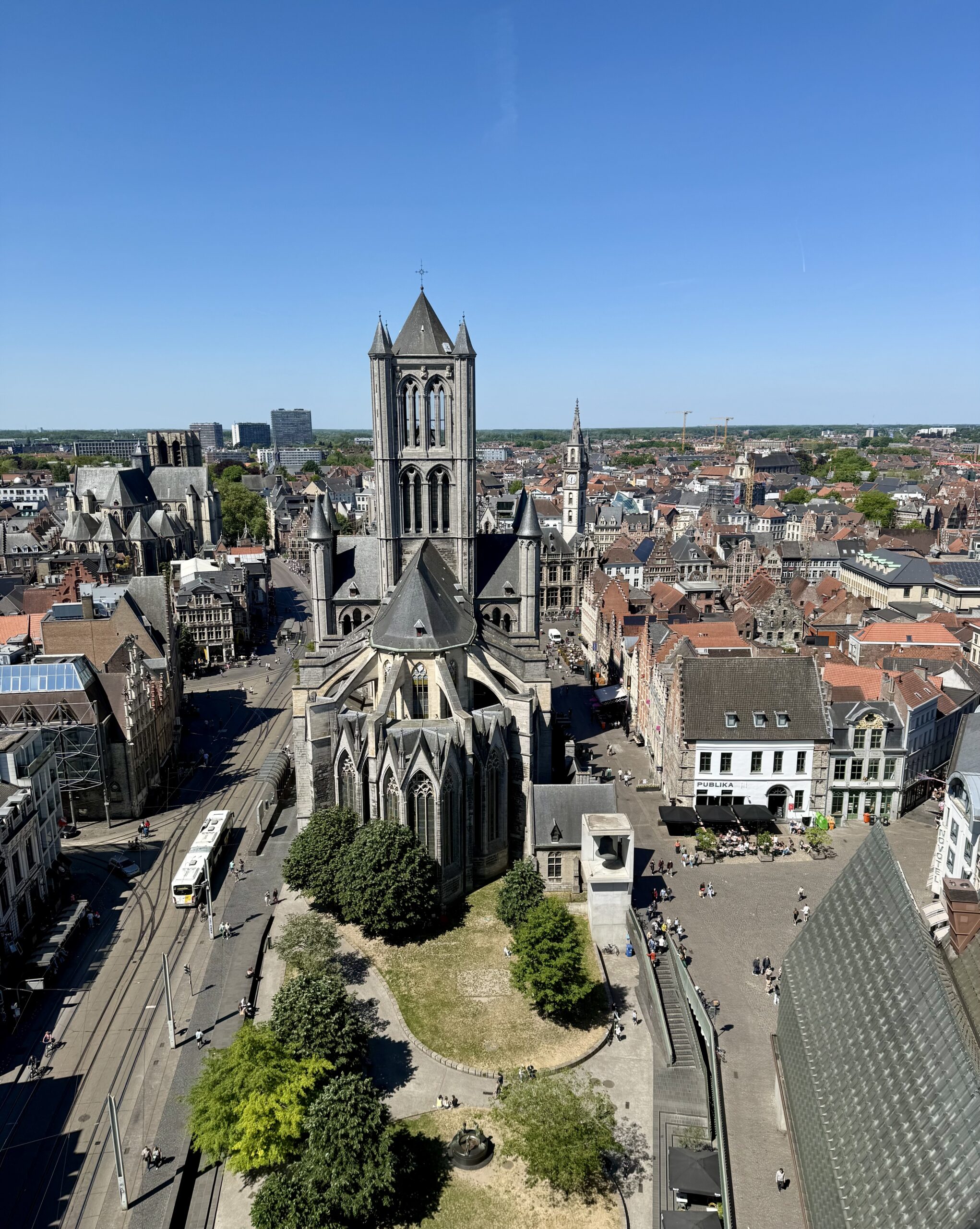
Ghent – City of Three Towers (St. Bavo’s Cathedral, St. Nicholas’ Church, the Belfry)
Ghent is the third largest city in Belgium, after Brussels and Antwerp. The city was originally founded due to its location where the River Scheldt and River Leie join. This made it an ideal spot for merchants to live and start growing their wealth. This is seen by the amazing architecture throughout the city, making it a great day trip from Brussels. It is a quick 30 minute train ride from Brussels, and on the way if you are heading out to Brugge. Brugge is another ideal tourist destination about an hour away from Brussels and a must see.
Previously, we explored Ghent as a stop over on the way to Brugge. Sadly it was during a torrential downpour that soaked us to the point of being miserable despite having raincoats which left a negative impression on us. With this in mind it seemed like a great time to do a redo. This time around Ghent lived up to the online hype about the architecture seems being right out of a Harry Potter film.
In order to get to downtown Ghent you could either walk the thirty minutes into downtown or use the public transportation system. We chose the convenience of public transportation which has a contactless payment system where you can buy your ticket once on board. After riding a few stops we jumped off to walk along the River Leie into downtown so we can cross the iconic stone arch St. Michael’s Bridge.


Castle of the Counts or Gravensteen is a medieval castle that dates back to the 800s. The original castle on the site was made out of wood to help store grain for the growing town. The existing castle was added on to, and became the residence for Counts of Flanders in 1180. After the Flanders left the castle took on a variety of different roles. It became a mint to print money during the 14th and 15th centuries, then a court and prison during the 18th century, cotton mill during the Industrial Revolution, and now a museum and tourist destination.

The Gravensteen was restored from 1893 – 1907 into a museum and tourist destination. When visiting the castle I would recommend doing the audio tour guide since there are very few signs to read and learn about the castle. We chose the 30 minute tour versus the hour long tour which did an excellent job providing enough information while not feeling overwhelming.

The turrets run along the back of the castle and provide a great view of the river.

How many people do you think used the medieval toilet before they decided to put up a do not use sign?
Next up on historic sites of Ghent is the Belfry, and it is listed as a UNESCO World Heritage Site. Originally we were not planning on visiting but I am glad we stopped by. The tower provides ample information in variety of languages. You climb the stairs to the first floor where you are greeted by a very large dragon, afterwards you are supposed to take the elevator up to the top. The elevator stopped and we accidentally got off on the second floor who showcases all the old bells once used in the tower. We ended up having to go back down to the first floor to catch the elevator to the top.
Ghent has been protected by a fire-spitting dragon on top of the belfry since 1377. During the sixteenth century barrels of burning tar helped create the illusion the dragon was actively spewing fire. The previous dragon was taken down in 1979 after several rounds of restoration attempts with bullet holes estimated from the Second World War. The current dragon was installed in 1980 using a helicopter and in 2018 breathed fire for the first time during Ghent Festivities. I think it should become a yearly occurrence, but sadly that is not the case (yet).

Prior to visiting the bell tower I assumed every time I heard a bell ring while in Europe someone was having to hand ring it, no matter how many times it had to go off. While I acknowledge that is completely infeasible and idiotic, especially since the original point of church bells was to help the villagers mark the time, it still made sense in my mind. Luckily for me the top of the belfry educated me on a vital mechanism I have never heard of – a carillon drum.
Carillon drums utilize hammers to externally strike the bells. The large drum is made up of two wheels with strips for pins utilized to create the notes in the melodies. When the drum is released it begins rotating to the right, the pin passes underneath a lever which then triggers the vertical wire to be pulled down which lifts the hammer. The hammer falls to ring the bell just as the pin clears the lever, which allows the lever to return to the original position ready for the next time.

The first carillon drum installed dates back to 1377, was made out of wood, and had a fixed musical pattern that could not be altered. During the 15th century an iron carillon drum was installed, which was later changed to a copper drum in the 17th century. The drum had 40 bells attached with 17,600 holes drilled into the drum for the individual pins to be placed. Currently there are 54 bells associated with the current carillon drum. The music is readjusted every two years during the Holy Week prior to Easter.
After you exit the bell room you can follow narrow paths along the outside of the Belfry. They provide excellent views of the city of Ghent at all angles. After you finish gawking at the views you can climb down the 300 medieval stairs in a tight spiral. Luckily the Belfry is organized and has it designated as one way traffic going down the tight spiral staircase. Some cathedrals allow two way traffic making it more sporting of an exit. As you are going down, there are stops along the way including the bell room on the second floor which we already discovered.


After finishing up at the Belfry it made sense to visit the other two towers of Ghent – St Nicholas’ Church and St. Bavo’s Cathedral. St. Nicholas’s Church tower is the tallest at 483 feet, compared to the Belfry of Ghent at 299 feet and St. Bravo’s Cathedral at 292 feet. Both are beautiful on their own and worth a visit. It helps to showcase how much wealth was in the city during the time of the merchants by having these incredible structures less than a five minute walk from each other.
We finished exploring and spent the rest of the day wandering the streets of Ghent. There is so much to see and explore. As you get a few streets away from the main tourist sites the crowds die down and the streets are full of adorable shops, cafes, and pubs. Overall I would recommend a half day to full day to explore all Ghent has to offer.